
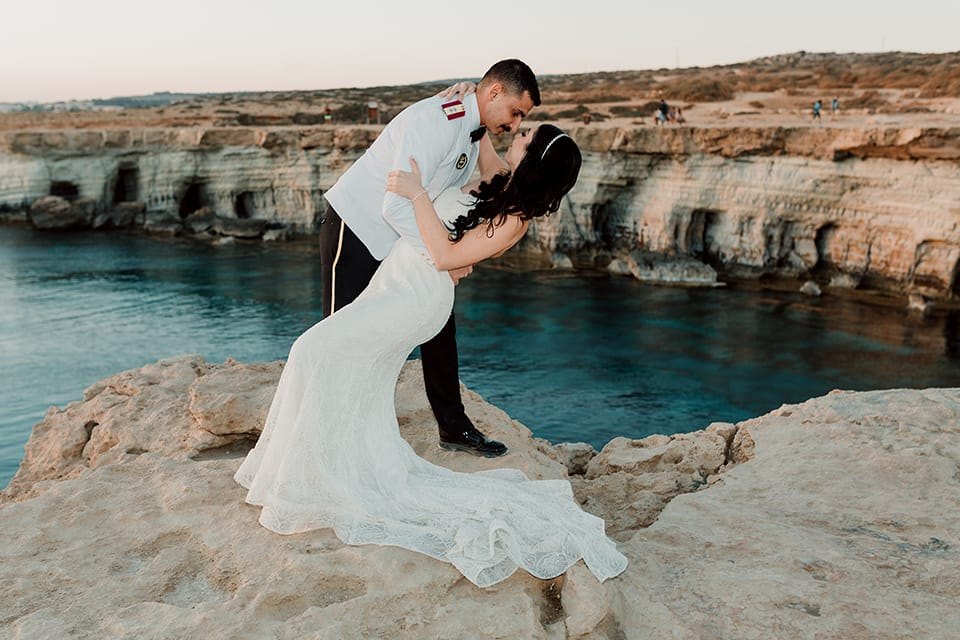
Cyprus is one of the easiest places in the Mediterranean to marry, and one of the most rewarding to photograph. Long, dependable summers, a coastline that changes character every few kilometres, stone villages an hour inland, and light in the evening that does most of the work for you.
This is a photographer’s guide rather than a planner’s one. It covers the things that shape how your day looks and feels — when to hold the ceremony, how the light behaves, how much time to leave, and what the island gives you that a wedding at home would not.
Choosing a region
Cyprus is small, but the regions photograph very differently, and most couples choose one and stay there.
Paphos has the most dramatic coastline — cliffs, sea caves and rock formations, with a rugged feel in the west. Limassol is the busiest and most cosmopolitan, with the widest range of large hotels and a long seafront. Ayia Napa and Protaras give you the postcard water, pale sand and turquoise sea. Larnaca is the quietest of the four and the most convenient for guests, being closest to the main airport. Inland, the Troodos villages trade the sea for stone, shade and cooler air.
I have written about each in more detail — Paphos, Limassol, Larnaca and Ayia Napa and Protaras — and if you have not chosen a venue yet, the guide to wedding venues in Cyprus covers the options region by region.

When to get married
Season affects your photographs more than almost any other decision you will make.
May, June, September and October
The best months, and not only for comfort. The heat is manageable, the evening light is long and warm, and the sea still looks its best. September and early October in particular give you summer conditions with softer light and fewer people in the background of your pictures.
July and August
Hot, bright and unforgiving in the middle of the day. Perfectly workable, but it changes the plan: the ceremony wants to be late, the portraits want to be at the very end of the day, and shade becomes something you plan for rather than hope for. Guests feel it more than you expect.
November to April
Quieter, greener and cheaper to travel to, with soft light all day rather than only at the edges. You trade reliability for it — rain is possible, and daylight ends early, which compresses the whole evening.
The light, and why the ceremony time matters most
If you take one thing from this guide, make it this. The single decision that most affects your photographs is what time the ceremony starts.
Cyprus sun in summer sits high and hard until late afternoon. An early-afternoon outdoor ceremony puts everyone in harsh overhead light, squinting, with deep shadows under the eyes. The same ceremony two or three hours later is a completely different set of photographs.
As a rough guide, the last hour before sunset is where the best portraits happen. In high summer that is around eight in the evening; by October it is closer to six; in midwinter it can be before five. Work backwards from sunset when you build your timeline, not forwards from lunch.
Which direction your venue faces matters too. The west coast around Paphos looks out over open water, so the sun sets into the sea in front of you. The south coast at Limassol faces sideways to the sunset, and the east around Protaras faces the sunrise instead — which is why a short morning-after session there can be worth the early alarm.

Church, civil ceremony, or somewhere of your own
Greek Orthodox ceremonies are the tradition here and have their own shape — a service that is shorter than most guests expect, low warm light inside the church, and a crowd that moves with you. Photographically they are rich, and the rules on where a photographer may stand vary from church to church, so it is worth asking early.
Civil ceremonies through a municipality are straightforward and popular with couples travelling in, and many hotels and private venues host their own ceremonies on site. If you are coming from Britain, the paperwork and timings are covered on the getting married in Cyprus from the UK page. Requirements do change, so confirm the current position with the municipality or your venue before you book flights.
Building a day that does not feel rushed
The most common mistake with a destination wedding is packing it. You have travelled a long way with people you rarely see. The photographs you will care about in ten years are mostly of those people, not of the two of you standing in a beautiful place.
A few things that consistently help:
- Get ready somewhere with daylight. A room with a large window is worth more than a large room.
- Leave a real gap between the ceremony and dinner. It absorbs the delays that always happen, and it is when the best unplanned pictures occur.
- Do family photographs in one block, with a list and somebody who can call names out. It takes a fraction of the time.
- Protect the last hour of light. Fifteen or twenty minutes away from your guests at the right moment is worth more than an hour at the wrong one.
- Plan for the heat. Water, shade, and a ceremony time that does not sit at the top of the day.

What to expect from the island itself
Distances look small on a map and take longer in practice, particularly on mountain roads and in August traffic along the coast. Anything more than about twenty minutes between locations starts eating your day.
Beaches in high season are busy and public. That is not a problem — it simply means the quiet, empty-beach photograph happens early in the morning or in the last light, not at four in the afternoon.
And the wind is a real factor near the coast, especially on the west. It is usually a gift for photographs, less so for hair, veils and place settings.

A short checklist before you book anything
- Pick the region first, then the venue — they are not interchangeable
- Check what time the sun sets on your date, then set the ceremony time around it
- Ask the venue where the ceremony faces and where the sun will be at that hour
- Leave more time between ceremony and dinner than you think you need
- Ask your photographer what happens if it rains, and what happens if they are ill
- If you want photographs at a second location, build it into the timeline rather than hoping
If you are planning a wedding in Cyprus and want to talk it through, get in touch with your date and where you are thinking of marrying. You can also see a full wedding in our photography and film pages.