
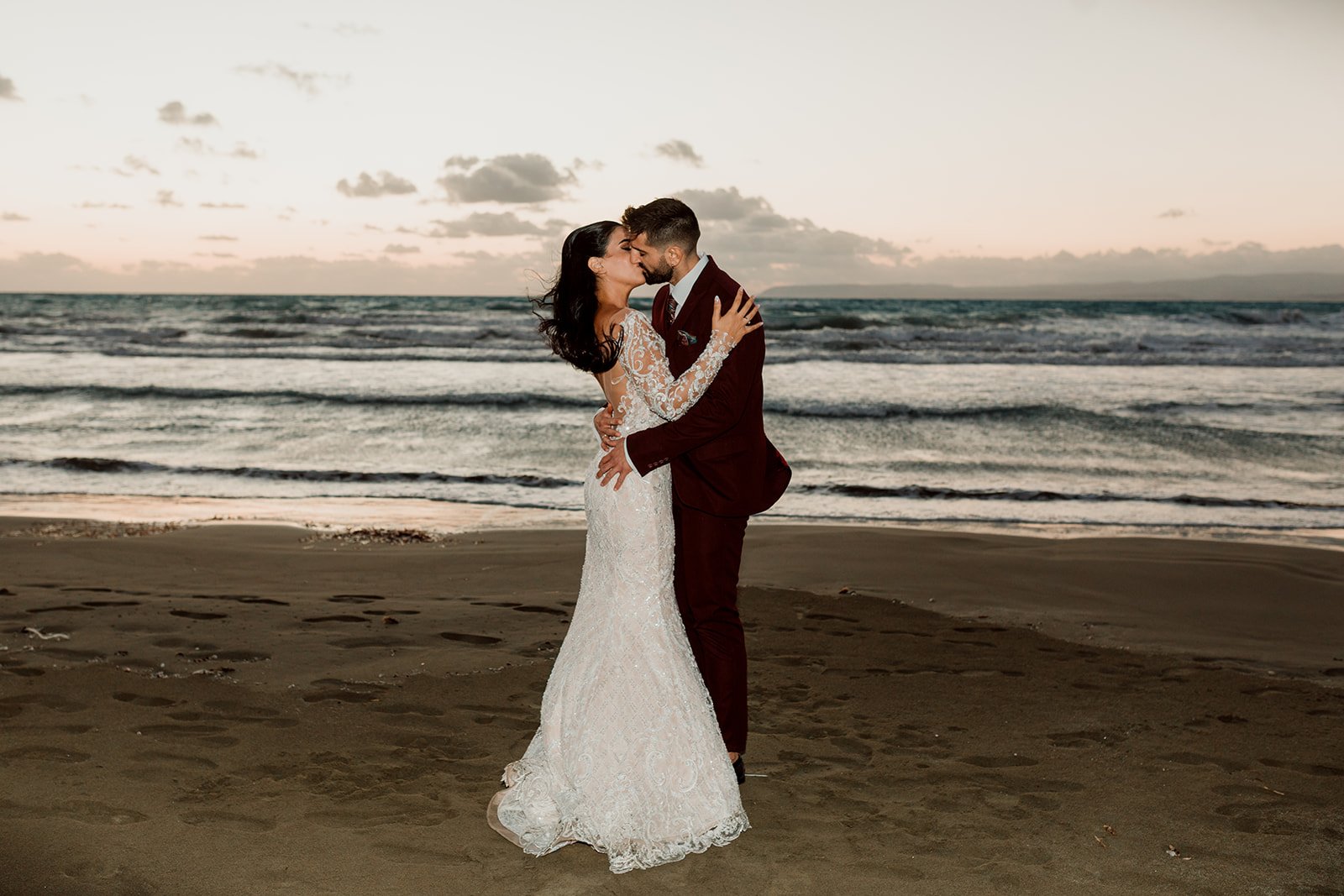
Almost every couple wants the same thing from their wedding day, and it is not a perfect one. It is to be present for it — to reach the end of the night having actually felt the day rather than managed it.
That is more learnable than it sounds, and some of what helps is the opposite of the advice you will be given. We photograph weddings for a living, which means we spend the whole day watching what makes the difference between a couple who enjoy their wedding and a couple who get through it. What follows pairs that with what psychologists have found about how people experience and remember the biggest days of their lives. Most of it is reassuring.
1. Aim for excited, not calm
This is the most useful thing on this page, and it is the opposite of what you will be told all morning.
Anxiety and excitement are almost the same physical state. Racing heart, tight chest, restless hands — your body cannot tell them apart. The difference is the label your mind puts on it. Trying to go from that high-arousal state to calm is a long jump. Going from anxious to excited is a short one, because you are already halfway there.
Harvard researcher Alison Wood Brooks tested this with people about to sing karaoke, give a speech, and sit a maths test. Those who said “I am excited” out loud performed measurably better than those who tried to calm down. When she asked people what advice they would give, about 85% said “try to relax” — the strategy that worked least well.
So on the morning: do not tell your partner to calm down, and do not tell yourself. Say out loud that you are excited. It sounds absurd. It works better than the alternative.

2. Nobody is watching as closely as you think
The single most common thing we hear from a bride before portraits is a version of “everyone is going to be looking at me”. They are, and they are not.
Psychologists call this the spotlight effect. In the classic study, Cornell researchers had students wear a deliberately embarrassing T-shirt into a room of strangers and then guess how many had noticed. They consistently guessed roughly double the real number. The catch is that the bias is entirely one-directional: when the same people watched someone else wear the shirt, their estimates were accurate.
Applied to a wedding: the mark on your dress, the hair that fell, the line you fumbled in your vows — you are experiencing them at full volume. Everyone else is at about half, and by the evening they have forgotten. This is not reassurance. It is measured.

3. You will remember it differently from how you live it
Daniel Kahneman’s work on memory found that we do not store experiences as an average of everything that happened. We store roughly two things: the most intense moment, and the end. He called it the peak-end rule, and the strangest part of it is duration neglect — how long something lasted barely registers in the memory at all.
This has three consequences for a wedding day, and they are worth planning around.
One bad hour will not ruin the memory unless it is the peak or the ending. The car being late at 11am will be gone. Something going wrong in the last hour will not be.
Protect one peak deliberately. Decide in advance what the moment of the day is for you — the first look, the vows, the first dance, the last hour of light — and defend it. Tell your planner. Tell us. Everything else can be compressed; that cannot.
Engineer the ending. Most weddings end by attrition: the music stops, people drift off, you go to bed exhausted. That fade is what you will remember disproportionately. Give the day a deliberate last beat instead — a final dance, a walk outside, five minutes alone on the terrace before you go up. It costs nothing and it changes the shape of the memory.

4. The one thing couples wish they had protected
When couples are surveyed about what they would change, the answers are remarkably consistent, and it is almost never the flowers or the food.
It is the timeline — feeling rushed, not having enough room — and above all not spending enough time together. Couples describe barely seeing each other between the ceremony and the end of the night. You are the two people the entire day is about, and you can very easily spend it in separate conversations at opposite ends of a room.
The fix is unromantic and it works: put time alone with each other in the schedule as a fixed item, the same way you would a speech. Twenty minutes after the ceremony, or during the couple session. Ask someone to guard the door. Nobody will schedule this for you, and if it is not written down it will not happen.
5. Decide everything before, so the day asks nothing of you
Decision-making is a finite resource. Every small choice you make — where should these people stand, do we cut the cake now, is it too windy for outside — draws from the same account, and by late afternoon the account is empty. That is why couples get snappy at 6pm about something trivial.
So decide everything in advance, then delegate the rest. If a question can be answered by anyone other than you on the day, it should be. This is the practical reason for the advice in our guide to preparing for your wedding photos: hand over the schedule, the details box, the group photo list. You are not being precious. You are protecting your capacity to be present.
6. Your mood sets the temperature of the room
Emotion is contagious, and at a wedding it flows downhill from the couple. Guests take their cue from you far more than from anything on the table. When a couple is visibly tense, the room becomes careful and polite. When they are visibly having a good time, everyone gives themselves permission.
There is a version of this that matters for photographs too. A room full of people who are relaxed produces the pictures couples say they love most — the ones nobody arranged. You have more influence over that than the photographer does.

7. The quiet week afterwards
There is a well-documented dip after a wedding, common enough to have its own name: the post-wedding blues.
The causes are straightforward once said out loud. You have spent a year in sustained, low-level stress with a clear goal, and then it stops overnight. You have been in daily contact with family, friends and suppliers, and then the phone goes quiet. And if a great deal of your identity has been invested in the wedding rather than the marriage, there is a hole where it used to be.
It is not a sign that anything is wrong. It helps to know it is coming, to plan something to look forward to in the month after, and to remember that the wedding was the beginning of the thing, not the thing itself.
It is also, quietly, the reason we do not rush the gallery. Photographs arriving weeks after the day, rather than the morning after, give you the wedding back at exactly the point you start to miss it.
What this means when the camera comes out
Almost everything above compounds into the same practical advice: the couples who photograph best are not the most photogenic, they are the ones who have decided in advance not to manage the day.
If you want the specifics of the preparation itself — tan lines, the details box, the group list, the heat — that is a separate guide. If it is standing in front of a camera that worries you, our guide to poses that actually work covers that. And if you want to know how the hours themselves tend to run here, we wrote up how a Cyprus wedding day actually runs.
Get in touch if you would like to talk any of it through.